

So, you want to build a morning routine that actually sticks. The secret is to craft a system that genuinely serves you, not one that looks good on someone else's Instagram feed. It's about defining your own goals, starting small, and building a flexible structure that can handle the chaos of real life.
Why Most Morning Routines Fail (And How Yours Won't)
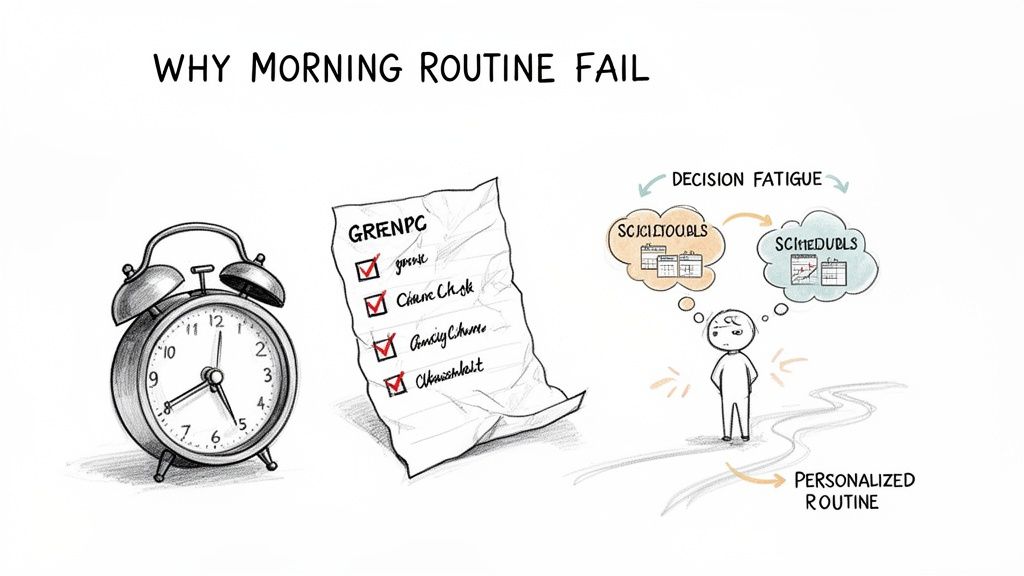 Let's get real for a second. The generic advice to "just wake up earlier" and follow some rigid checklist is a recipe for disaster. Most of these well-meaning routines completely fall apart within a few weeks, leaving you feeling more defeated than energized.
This isn't a personal failure. It’s a design flaw.
The trouble often starts when we try to copy the routine of some high-flying CEO we saw online—you know the one, with the 5 AM ice bath, an hour of journaling, and a green juice. This one-size-fits-all approach completely ignores your unique lifestyle, energy levels, and what you actually want to achieve. It's unsustainable from day one.
The All-or-Nothing Trap
One of the biggest culprits I see is the all-or-nothing mindset. You map out a perfect, 60-minute plan, but the first time you hit snooze or a kid wakes up early, the whole thing feels shot. So instead of doing something, you do nothing, vowing to get back on track tomorrow.
It's a vicious cycle of perfectionism and abandonment, and it's why so many routines never become actual habits.
A successful morning routine isn't about perfection; it's about consistency. Think of it as a tool to support you, not a strict set of rules designed to make you feel guilty when life inevitably gets in the way.
The Real Reasons Routines Fall Apart
Beyond just setting unrealistic expectations, a few other common snags derail morning rituals before they ever get off the ground:
- Decision Fatigue: Waking up to a long menu of choices—Should I meditate or journal? Run or stretch?—drains your mental fuel before you've even had coffee. The best routines are almost automatic.
- No Personal 'Why': Without a clear, personal reason driving your actions, a routine just feels like a list of chores. If your habits aren't tied to an outcome you genuinely care about, your motivation will fizzle out fast.
- Overwhelming Complexity: Trying to bolt on five new habits at once is a surefire way to get overwhelmed. This is a super common challenge, and our guide on what to do when you feel overwhelmed by tasks offers some solid strategies for simplifying your focus.
The key to creating a morning routine that lasts is to build a personal, flexible framework. Forget the rigid schedule. Instead, think of it as a strategic toolkit for reclaiming your focus and setting a positive tone for the day—one that can bend without breaking.
Defining What a Great Morning Looks Like for You
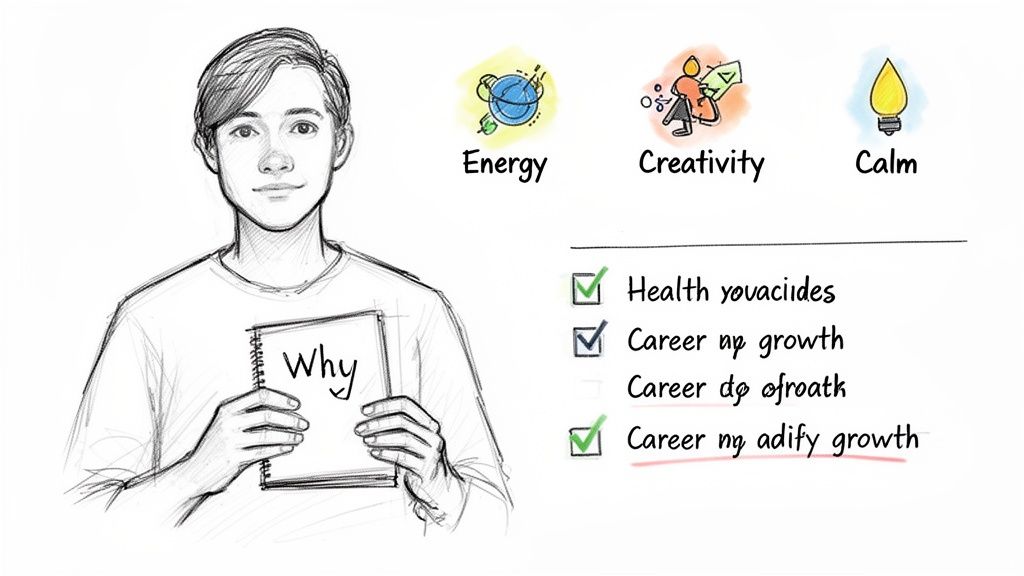 Before you even think about adding a single habit to your morning, we need to get one thing straight. A morning routine without a clear purpose is just a checklist of chores. The real goal is to design a morning that gives you more energy than it takes.
So, let’s start with a simple question: What do you truly need from your mornings?
Maybe you crave a pocket of quiet, creative time before the rest of the house wakes up. Maybe you need a jolt of physical energy to power through a demanding workday. Or perhaps you just want a moment of calm to ground yourself before the day’s chaos inevitably kicks in.
Connect Your Actions to Your Goals
Your 'why' is the engine that will get you out of bed on those mornings when motivation is nowhere to be found. It’s the difference between begrudgingly lacing up your running shoes and eagerly stepping outside because you know it’s fueling your goal of feeling stronger and more alive.
This isn’t just a feel-good idea; it’s part of a huge global shift. A recent study found that 84% of US consumers now see wellness as a top priority. People are actively looking for ways to beat burnout and improve their health, which makes having an intentional routine more important than ever. You can dig into the full Future of Wellness report to see how this is reshaping daily habits.
To connect your big-picture goals to small, daily actions, start by asking yourself a few pointed questions:
- Health & Energy: How do I want to feel physically by 9 AM? (e.g., energized, hydrated, less stiff)
- Career & Focus: What one thing could I do this morning to set my workday up for success? (e.g., review my top 3 priorities, clear my head for deep work)
- Mindset & Calm: How can I start the day feeling more positive or peaceful? (e.g., gratitude practice, 5 minutes of meditation)
- Personal Growth: What skill or interest do I want to make time for, even if it's just for 15 minutes? (e.g., read a chapter, practice a language)
Your answers are the blueprint for your routine. Each habit you choose should directly serve one of these personal outcomes. That's how a morning starts feeling purposeful instead of just another list of things to do.
From Vague Ideas to a Concrete Plan
Once you know what you want to achieve, you can brainstorm specific, small actions that get you there. This is a game-changer for building a sustainable system that actually supports a healthier work-life balance.
A great way to map this out is with a simple table. It forces you to be intentional and see exactly how each little habit serves a larger purpose.
Mapping Your Morning Habits to Life Goals
Life Domain (e.g., Health, Career, Mindset)My Desired Outcome (e.g., Feel More Energized)Potential Morning Habit (e.g., Hydrate, 10-min stretch)Time EstimateHealthFeel energized and ready for the dayDrink a full glass of water upon waking2 minutesMindsetStart the day with a clear, calm mindMeditate or do deep breathing exercises5-10 minutesCareerBe more proactive and less reactive at workReview my top 3 priorities for the day5 minutesPersonal GrowthLearn a new skill consistentlySpend time on a language app or read a book15 minutesFilling this out for yourself connects the dots between what you want and what you do. It’s a simple but powerful exercise.
And remember, a truly great morning often starts the night before. Getting enough sleep is non-negotiable if you want to wake up ready to go. If that's a struggle, check out these proven strategies to improve sleep quality to set yourself up for success.
This foundational step of defining your 'why' is easily the most important. It ensures every action has a purpose, transforming your morning from a series of obligations into a powerful tool for building the life you actually want.
The Essential Building Blocks of an Effective Morning
Every truly great morning routine is personal, but that doesn't mean you have to invent it from scratch. The most effective ones are built on a few core pillars—foundational habits that are proven to set your day up for success. Think of these as your core ingredients; you just have to find the recipe that works for you.
And no, your morning routine doesn't need to be some hour-long, monumental effort. The real magic is in small, consistent actions that give you a huge return on your energy. For a busy parent, a five-minute meditation might be the only quiet moment they get all day. For a remote worker, that 30-minute workout could be non-negotiable. The goal here is accessibility, not complexity.
It’s all about picking a few key activities that reliably shift your mood and sharpen your focus. Funny enough, most of us are already doing this without even thinking about it. A recent study on daily routines found that 65% of people start their day by brushing their teeth, 60% make a point to drink water, and 51% brew coffee or tea. These simple rituals are the bedrock of a productive day.
Hydration and Movement
Let's start with the easiest win: rehydration. After 7-8 hours of sleep, your body is naturally dehydrated. A glass of water before you do anything else is a simple way to kickstart your metabolism and wake up your brain. It’s a two-minute action with an immediate payoff.
Next up, get moving. This isn't a command to start a punishing 5 AM workout. It can be a simple 10-minute walk around the block, a few gentle stretches on a yoga mat, or even just some mobility exercises while your coffee brews. The point is just to wake up your body, get the blood flowing, and shake off that morning stiffness.
The goal isn't to become a morning workout fanatic overnight. It's to find a form of movement you genuinely enjoy and can stick with, even if it’s just for five minutes. Consistency beats intensity every single time.
Mindfulness and Focus
Okay, your body is awake. Now it's time to ground your mind. This is your defense against starting the day in a reactive tailspin—you know, the one that begins with immediately checking emails or scrolling through social media.
This piece of the puzzle can look different for everyone. Find what clicks for you:
- Meditation: Just 5-10 minutes of a guided app or even silent sitting can slash stress and sharpen your focus for the day ahead.
- Journaling: This could be a "brain dump" to get all the noise out of your head, jotting down three things you're grateful for, or setting a clear intention for the day.
- Reading: A chapter from an actual book—not the news—can be incredibly calming and inspiring before the world starts making demands on your time.
The final pillar is a slice of focused work or learning. This is about carving out a small, distraction-free block of time—maybe just 15-20 minutes—for your single most important task or a personal growth goal. It's the old "eat the frog" trick. Ticking off a meaningful task first thing builds incredible momentum and gives you a win before the day has even really begun.
If you're looking for a good way to keep yourself honest with these new habits, our guide on the best habit tracking apps has some great options. By pulling these building blocks together, you're not just creating a routine; you're building a reliable framework for a better day.
Assembling Your Routine with Habit Stacking
Alright, you've figured out the individual habits you want in your morning. Now, how do you string them together so they actually happen?
This is where a neat little psychological trick called habit stacking comes into play. It’s a game-changer for making new habits feel effortless by linking them to behaviors you already do on autopilot.
Instead of trying to remember a brand-new to-do list every morning, you just piggyback the new habit onto an existing one. The formula couldn't be simpler: "After [Current Habit], I will [New Habit]." This creates an automatic trigger that tells your brain what's next, no willpower required.
Suddenly, your routine isn't a clunky checklist anymore. It's a smooth, natural flow where one action kicks off the next, building momentum without you even thinking about it.
This visual shows a simple four-step flow: hydrate, move, mind, focus. Each step logically prepares you for the one that follows, creating a positive cascade effect.
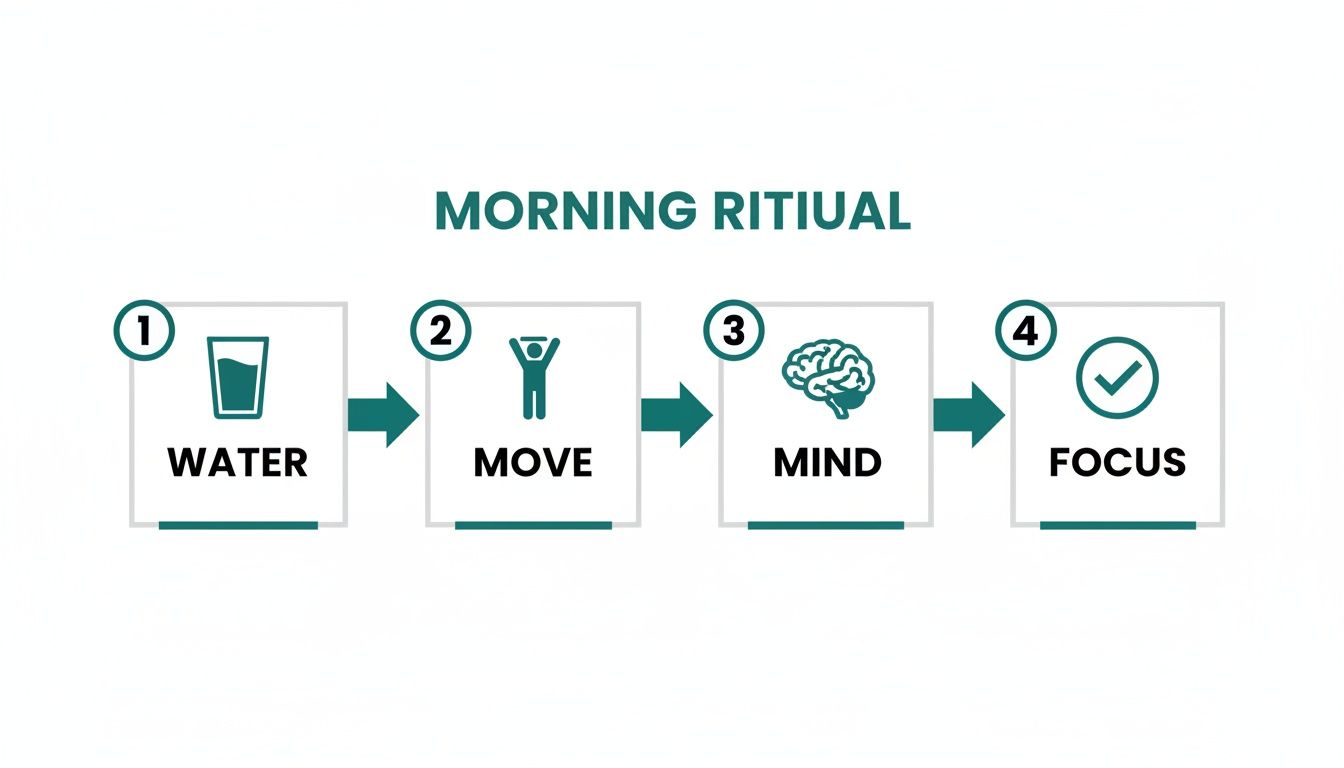 The real magic here is in the sequence. You're building a chain reaction that carries you forward.
Crafting Your Habit Stack
So what does this look like in the real world, especially when you're still half-asleep? It’s about creating a logical chain of activities that just makes sense.
Here are a few practical examples you can steal or adapt:
- The Quick Win: "After I turn off my alarm, I will immediately drink the glass of water on my nightstand. After I finish the water, I will do five minutes of stretching next to my bed."
- The Mindful Start: "After my coffee maker starts brewing, I will sit down and write in my journal for five minutes. After I finish journaling, I will review my top three priorities for the day."
- The Energizer: "After I put on my workout clothes, I will head outside for a 15-minute walk. After my walk, I will spend five minutes meditating."
The beauty of habit stacking is that you're not pulling new behaviors out of thin air. You're just slotting them into the tiny pockets of time that already exist in your morning.
Of course, designing the perfect stack is just one piece of the puzzle. The real challenge is making it last. To do that, you need a solid grasp of how to pick up productive habits that stick. Skipping this part is why so many new routines fall apart after a few days.
My advice? Start small. Really small. Just stack two or three habits together. Once that feels completely automatic, then you can think about adding another link to the chain. Trying to build a ten-step routine from day one is a recipe for failure.
Using Automation to Ensure Effortless Consistency
You've designed your perfect routine. You’ve even mastered habit stacking. So what’s the final piece of the puzzle to make it all stick for good?
Simple: you have to remove the mental energy of remembering what to do next.
Willpower is a finite resource, especially right after you wake up. Lasting consistency doesn't come from forcing yourself through a checklist; it comes from automation. While habit trackers are great for logging what you've done, the real secret to effortless follow-through is a system that works for you in the background. A small productivity hack can make all the difference, giving you the gentle nudges you need without adding another complicated app to your life.
Think about it: we crave convenience. It’s why research shows a staggering 90% of morning meals in the US are prepped in 15 minutes or less. Busy professionals and families just don’t have time for more. You can explore the full insights from Circana's report here. Just like a quick breakfast, your routine's support system needs to be fast, simple, and effective.
Introducing an Invisible Tool for Your Routine
This is where a tool like Recurrr becomes a hidden gem. It’s not a habit tracker or a project management app you have to constantly check. Think of it as an "invisible tool" that sends simple, recurring reminders right to your email inbox, exactly when you need them.
You can set up gentle prompts that run on autopilot, like:
- A 7:00 AM email that says, "Time for your 15-minute walk."
- A 7:20 AM nudge to "Review today's top 3 priorities."
- An 8:00 AM reminder to "Spend 10 minutes journaling."
It’s a lightweight system that removes the cognitive load of remembering your sequence. The prompt arrives, you do the thing. It’s that simple. To see how this fits into a broader productivity strategy, our guide on what workflow automation is provides great context.
Here's a look at just how simple it is to set up a recurring task in Recurrr to keep your morning habits on track.
As you can see, the clean interface makes scheduling your morning nudges a matter of a few clicks.
Why This Simple Hack Works So Well
The power of this approach is its beautiful simplicity. You aren't managing another dashboard or getting distracted by a feature-heavy app. You're just getting a timely prompt in a place you already check—your inbox.
This method turns your email into a personal accountability partner that doesn't judge or overwhelm. It just quietly guides you through the routine you designed for yourself, making consistency the path of least resistance.
By automating the "remembering" part of your routine, you free up your mental space to focus on the "doing." This subtle shift is often the final piece needed to create a morning routine that doesn’t just look good on paper but becomes an effortless and permanent part of your life.
Your Top Questions About Morning Routines, Answered
When you start carving out a new morning routine, a few questions always seem to pop up. Let's be honest, turning a good idea into an actual habit can feel tricky. Clearing up these common doubts is often the key to making it stick.
So, let's dive into the big questions people have when they decide to get intentional about their mornings.
What’s the "Best" Time to Wake Up?
Forget what the 5 AM club gurus tell you. There's no magic, one-size-fits-all "best" time to wake up. The right time for you is whatever works with your body's natural rhythm (your chronotype) and the real-world demands of your life.
The secret sauce isn't the number on the clock; it's consistency.
Seriously. Waking up at the same time every single day—yep, even on weekends—is what regulates your internal clock. It makes getting out of bed feel less like a battle. Just give yourself enough of a buffer to move through your routine without feeling rushed, whether that’s at 5 AM or 8 AM.
How Long Before This Routine Feels Natural?
You can toss out that old "it takes 21 days" myth right now. Modern research shows it's closer to 66 days on average for a new behavior to become automatic. And even that's just an average—the real range is huge, from 18 days for some to over eight months for others.
It all depends on you and how complex the new habit is. Instead of getting hung up on a deadline, just focus on showing up day by day. This is where a simple productivity hack, like setting up automated reminders, can be a game-changer while that new habit is still finding its footing.
The point isn't to hit some magic number of days. It's to string together enough small wins that doing the routine becomes easier than not doing it.
What if I Miss a Day?
First off, breathe. Missing a day doesn't mean you've failed. It means you're human. Life throws curveballs—you get sick, sleep terribly, or a kid has an emergency. It happens.
The most important rule is simple: never miss twice in a row.
If you skip Monday, your only job is to get back on the horse Tuesday. So many people get derailed by all-or-nothing thinking. A good routine has flexibility built in. The goal here is long-term consistency, not short-term perfection.
Ready to make consistency feel effortless? Recurrr is the simple, invisible tool that sends recurring reminders right to your email. It takes the mental load off your plate so you can just do the routine. Start automating your habits and build the morning you actually want. Get started with Recurrr.