


Learning to delegate well is a massive unlock for any leader. It's about moving past the impulse to just get rid of tasks and starting to use delegation as a strategic tool—one that scales your impact and grows your team.
This means figuring out the right tasks to hand off, picking the best person for the job, giving them instructions that are actually clear, and then following up without breathing down their neck.
Why Delegation Is Your Most Powerful Leadership Tool
Ever feel like you're drowning in a sea of small, repeatable tasks while your most important projects just sit there, stalled? You're not alone. So many leaders fall into the 'I can do it faster myself' trap. We see delegation as a loss of control, or maybe even a burden on our team.
But that whole mindset is a direct roadblock to growth.
What if we reframed it? Effective delegation isn't about getting rid of work; it's about multiplying your impact. When you figure out how to delegate tasks the right way, you create a ripple effect that helps everyone.
When you make that mental switch, delegation stops being a simple hand-off and becomes a core leadership function with some seriously tangible benefits:
- You get your time back. Offloading the right tasks pulls you out of the weeds. It frees you up to focus on high-level strategy, creative problem-solving, and setting the vision—the work that only you can do.
- You develop your people. Giving team members new responsibilities is a powerful way to show trust and invest in them. It’s a chance for them to learn new skills, build confidence, and grow into bigger roles.
- You build a stronger, more resilient organization. When skills and responsibilities are shared, the team becomes way less dependent on any single person (including you). This builds real operational strength and helps how to improve team efficiency across the board.
The link between delegation and success isn't just some feel-good theory; it's backed by hard numbers. Leaders who master this don't just get more done—they build stronger, more capable teams that drive real results.
And the financial impact is undeniable. One eye-opening study of 143 Inc. 500 CEOs found that leaders with strong delegation skills saw a staggering 1,751% three-year growth rate. That was 112 percentage points higher than their peers who struggled to let go of tasks.
Other data shows that CEOs who delegate well generate 33% more revenue than those who micromanage. If you're curious, you can dig into more of these powerful delegation statistics.
Identifying High-Impact Tasks to Delegate Today
Before you can even think about delegating, you have to know what to delegate. This isn't about just flinging tasks at your team and hoping something sticks; it's a careful, strategic look at your own workload.
The first step is brutally honest: list out everything you're working on. I mean everything. From the massive, multi-month projects right down to the little nagging items that pop up every single week and eat away at your focus.
Feeling overwhelmed often comes from a fuzzy picture of where your time is actually going. If you feel like you're constantly pedaling but not moving forward, it's time to get clear. Our guide on what to do when you have too much to do and too little time can help you cut through that fog. Once that list is staring back at you, it's time to sort it out.
The Time and Skill Audit
Here’s a simple but incredibly effective method I use: the Time/Skill Audit. Grab your list and ask two blunt questions for every single item:
- Does this really need my unique skill set? Is this a task that only I, with my specific experience and knowledge, can handle? Or could someone else learn to do it, maybe even better than me, with some guidance? Be honest. It's easy to think we're indispensable for tasks that are actually quite teachable.
- How much time is this really costing me? Look at the recurring, time-sucking tasks. They might seem small in the moment, but they add up fast. These are prime candidates for delegation.
Let's make this real. A marketing director might realize they're burning 5 hours a week pulling numbers for a status report. It's an important task, sure, but it doesn't need their strategic brain. That's a perfect hand-off. A founder might be scheduling social media posts for an hour a day—that's valuable mental energy that could be spent growing the business instead.
This simple audit naturally highlights the three massive wins of delegation: you get to scale your impact, develop your people, and focus on the work that actually moves the needle.
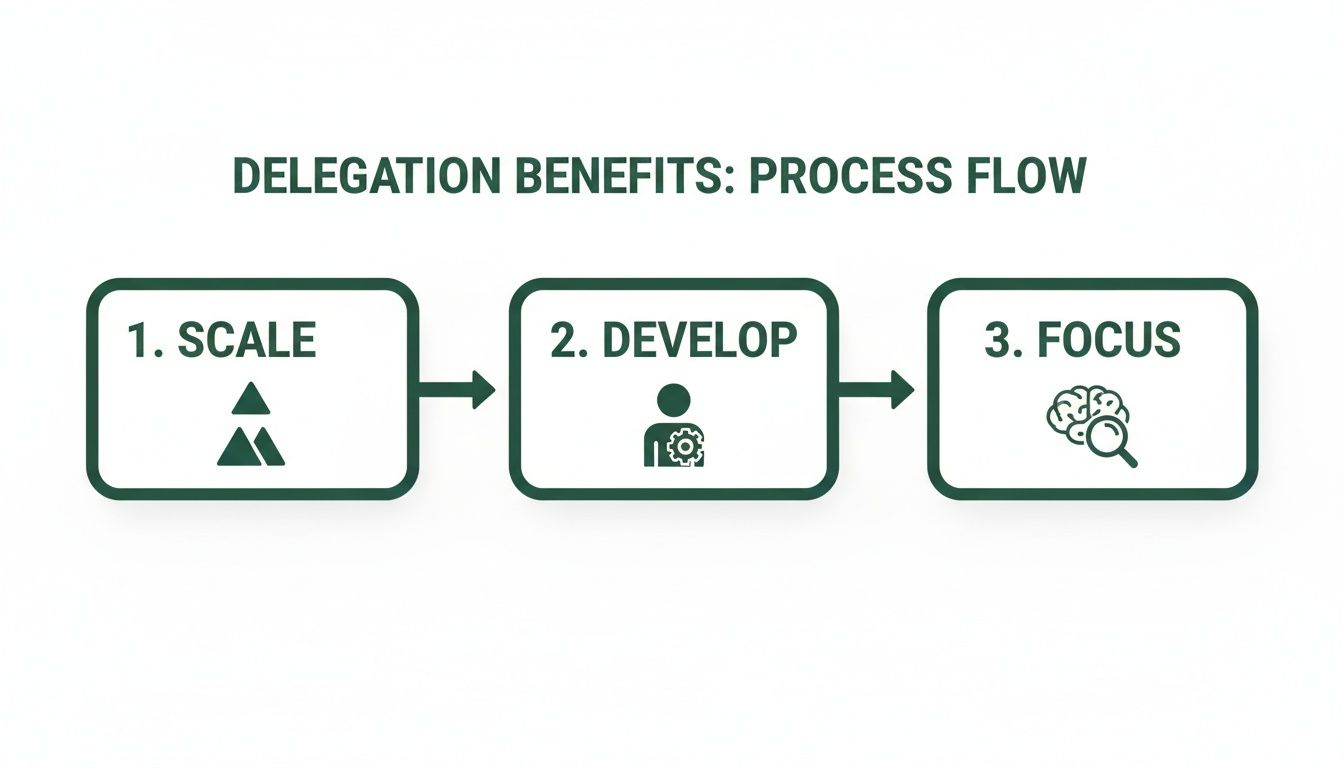 As you can see, offloading the right tasks creates a powerful cycle that fuels both your growth and your team's.
Need a quick way to vet a task? Run it through this simple checklist.
Quick Task Delegation Checklist
Question to AskIf Yes…If No…Is this a recurring task?Great candidate for delegation and automation.Keep it for now, unless it's a one-off project.Does someone else on the team have the skills (or could they learn)?Perfect! This is a growth opportunity for them.This might be a task only you can do. Hold onto it.Is this task in my "genius zone" (high-impact work I love)?Keep it. This is where you provide the most value.This is a strong sign you should delegate it.Does it drain my energy and focus?Delegate it immediately. Protect your focus.This is likely a good use of your time.This isn't an exact science, but it's a powerful filter to quickly spot the low-hanging fruit on your to-do list.
Spotting Growth Opportunities for Your Team
Delegation isn't just about clawing back your own time. Look at your list and ask: which of these tasks could be a genuine development opportunity for someone on my team?
Maybe a junior team member is eager to get more experience with client communication. Why not have them start by drafting the initial outreach emails you used to write? The task gets done, and they get valuable, hands-on experience.
Delegation is not just about offloading work; it's about upskilling your team. A task that feels tedious to you might be a valuable learning experience for someone else, building their confidence and capabilities.
When you see it this way, delegation changes completely. You’re no longer just getting things off your plate. You’re actively investing in your team’s skills and turning a simple task hand-off into an act of mentorship. That’s a win-win.
Matching the Right Person to the Right Task
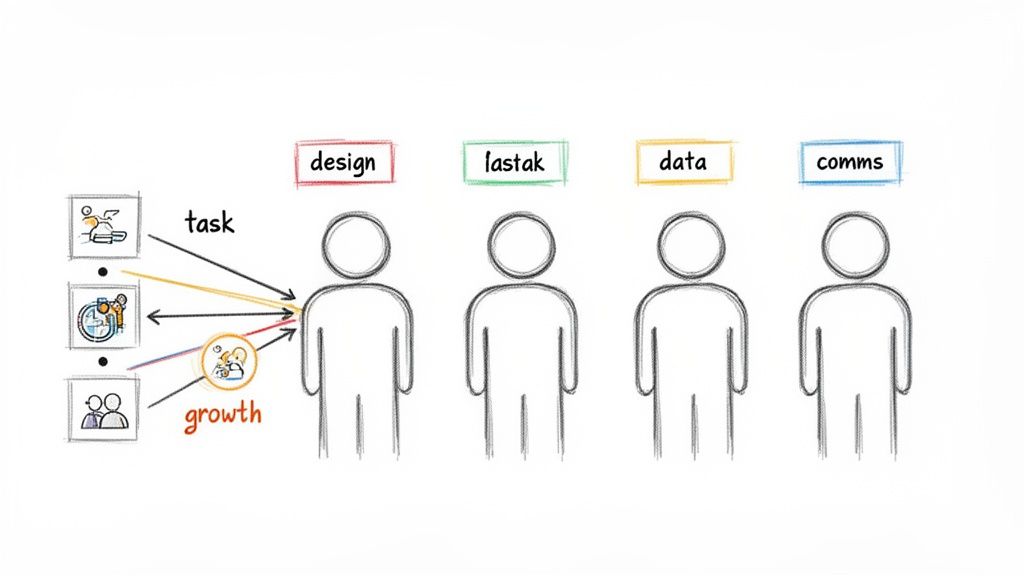
Giving a task to the wrong person can easily create more work than it saves. Real delegation isn't just about seeing who has some free time on their calendar. It’s more of an art form, a kind of matchmaking. You have to look at your team not just as a list of available people, but as a group of individuals with unique skills, ambitions, and career paths.
Before you hand anything off, you need a crystal-clear picture of three things:
- Current Skills and Strengths: Who on your team is already a rockstar at this kind of work? Playing to someone's strengths is a surefire way to get a great result and boost their confidence.
- Developmental Goals: Who wants to get better at this? A task that feels like a Tuesday chore to a senior team member could be a game-changing opportunity for someone more junior.
- Present Workload: Is the best person for the job already buried in other projects? Overloading your top performers is the fastest way to burn them out. The perfect match won't work if they're already drowning.
 ### From Hand-Off to Mentorship
When you line up a task with someone’s career goals, delegation stops being a simple hand-off and becomes an act of mentorship. It sends a powerful message: you're paying attention to their aspirations and you trust them with more responsibility. That small shift in perspective can do wonders for team morale.
Think about it. Instead of just giving a junior designer another banner ad to crank out, why not let them take a crack at a low-risk internal project? Maybe they could design the new company newsletter template. The stakes are low, but the chance to own something from start to finish is a huge confidence booster. You're not just checking a task off your list; you're building a more capable team member.
This stuff is critical for keeping your best people around. Poor delegation is a huge reason people quit. In fact, a staggering 79% of voluntary resignations are linked to a 'lack of appreciation,' which often includes managers who don't hand off tasks that unlock growth. Further research on staff satisfaction backs this up, showing that smart delegation is a direct line to employees feeling valued.
Connecting the Task to the Bigger Picture
Once you’ve got the right person in mind, the final piece is explaining the "why." Never, ever just drop a task on someone's plate without context. Take a minute to explain how this specific piece of work plugs into the larger project or the company's goals.
"People don't just want to be told what to do; they want to understand why their work matters. Connecting a delegated task to a larger mission provides purpose and motivates a higher standard of work."
For example, don't just say, "Please research these three competitors." That's flat and uninspiring.
Instead, try something like, "We're exploring a new product feature, and I'd love for you to lead the initial competitive research. Your findings will directly shape our strategy for the next quarter." The task is identical, but the second version gives it purpose and a sense of ownership. This approach is especially effective when working with freelancers who need to feel like part of the team. If you're looking for ways to manage external talent more effectively, take a look at our guide on project management tools for freelancers.
By thoughtfully matching the person to the task and clearly explaining why it matters, you're not just delegating—you're building a more engaged, skilled, and motivated team.
How to Give Instructions That Get Results
If there's one place delegation consistently falls flat, it's in the handoff. I've seen it happen a hundred times. You can pick the perfect task and the right person, but if your instructions are a fuzzy, half-baked idea, you're not delegating—you're setting a trap.
Getting the idea out of your head and into a concrete plan is the single most critical part of this whole process.
Think of your instructions as a blueprint. A casual request like, "Hey, can you pull a report on Q3 social media?" leaves a massive canyon of ambiguity. Which metrics? Who's the report for? What format? This kind of vagueness doesn't just create stress; it practically guarantees the final product will miss the mark.
 To make sure your instructions land and lead to flawless execution, you have to constantly improve team communication skills. It’s not just about what you say, but about building a shared understanding from the get-go.
Crafting the Perfect Delegation Brief
Instead of a drive-by request in Slack, get into the habit of creating a simple but solid brief. This doesn't need to be a ten-page formal document for every little thing, of course. But for anything with a bit of meat on it, a brief provides the clarity people need to run with the task.
The goal here isn't to micromanage with a step-by-step manual. It's to provide a clear framework.
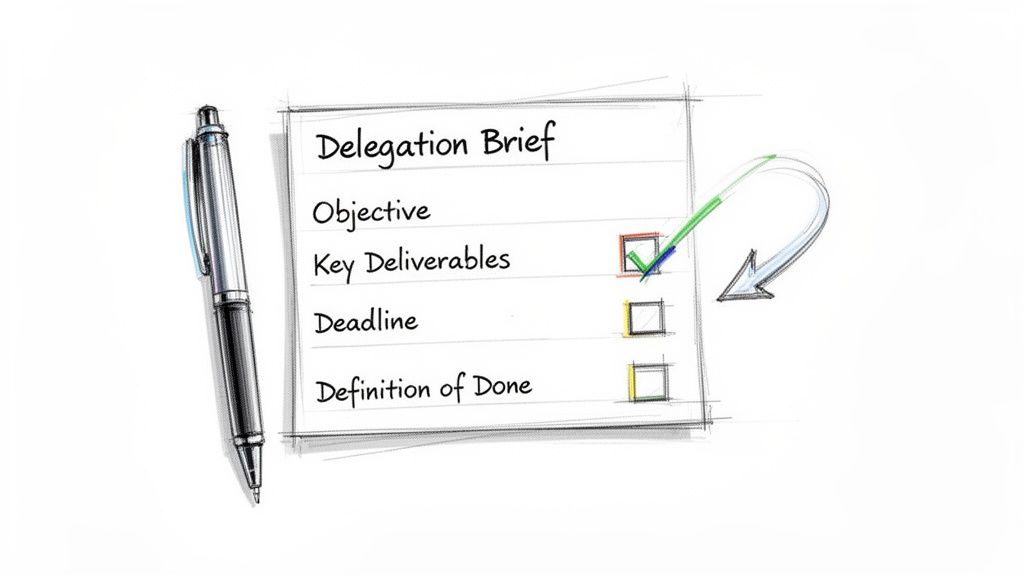
Every good brief I've ever written or received contains four key things:
- Objective: Start with the "why." What's the ultimate goal here? For instance, "The goal of this report is to show the leadership team which social channels are driving qualified leads, so we can better allocate our budget next quarter."
- Key Deliverables: What tangible thing are you expecting at the end? Be specific. This could be a PowerPoint deck, a spreadsheet with the raw data, or a drafted blog post.
- Deadline: When is it actually due? A clear, firm date is non-negotiable. For bigger projects, I like to set one or two check-in dates along the way to make sure things are on track.
- Definition of Done: How do we both know, without a doubt, that this task is complete? For example, "This is 'done' when the final presentation is saved to the shared drive and I've been tagged on Slack."
Providing clear boundaries and a well-defined outcome doesn't stifle creativity; it enables it. When people know the rules of the game and what winning looks like, they have the freedom and confidence to play their best.
Think about it this way: delegating a market research report needs a detailed brief with specific data points to hunt for. But delegating a client presentation might focus more on the key takeaway message and the desired feeling, giving the designer more creative freedom on the visuals.
When you adapt your instructions to the task and provide this simple framework, you swap guesswork for purpose. You give your team the power to take real ownership and deliver exactly what you need, without the endless back-and-forth.
Automating Delegation with This Simple Productivity Hack
Not every task you delegate is a massive, complex project. In fact, some of the most draining work comes from the small, repetitive stuff that eats up your mental bandwidth—the constant follow-ups, the weekly check-ins, the monthly reminders. This is where a simple productivity hack can completely change the game.
Instead of reaching for another heavy, all-in-one project management app, think smaller. Consider an invisible tool that automates the delegation of recurring communications. It's a hidden gem for lifting the mental load of remembering to remind other people to do things. This is a small productivity hack you can use in addition to your other tools.
Set It and Forget It Delegation
I call this the ‘set-it-and-forget-it’ approach to delegation. A team lead can schedule an email that automatically asks for progress updates every single Friday afternoon. Done. An accountant can automate monthly invoice reminders to every client without lifting a finger. It’s a tiny shift, but it ensures consistency without demanding your direct, manual effort each time.
This strategy is a direct countermeasure to burnout, which so often comes from the relentless pressure of juggling endless small details. Burnout is a silent killer of productivity, and smart delegation is one of the best antidotes.
But here’s the alarming part: only 19% of over 70,000 managers assessed show strong delegation skills. That leaves a massive majority vulnerable. With burnt-out leaders being 3.5 times more likely to quit their jobs, tools that automate recurring follow-ups are no longer a luxury—they're essential.
Tools like Recurrr are built for exactly this kind of lightweight, recurring communication. If you want to go a bit deeper on the principles behind this, getting a handle on workflow automation is a great place to start.
When you automate these simple but necessary pings, you free up so much cognitive space. It’s not about replacing your main project tools. It’s about adding a small, powerful hack to your toolkit to handle the quiet energy vampires. You can learn more about how to automate repetitive tasks and start reclaiming your focus for the strategic work that really matters.
Mastering Follow-Up Without Micromanaging
Handing off a task isn't the end of the story. Far from it. That moment is actually the starting gun for the final, most delicate phase: the follow-up. This is where you walk the fine line between staying in the loop and becoming the dreaded micromanager.
Your goal here is to monitor progress, not to hover over someone's shoulder. It's about building a system of trust that empowers your team member while making sure the work doesn't fall off the rails. The secret? Agree on a check-in schedule before the work even starts. This makes it a natural part of the process, not a knee-jerk reaction to your own anxiety.
Setting a Cadence for Check-Ins
How often should you check in? It all depends on the task's complexity and deadline. A simple, one-day task probably just needs a quick confirmation at the end of the day. But a project spanning two weeks? That needs a bit more structure.
- For quick tasks (1-2 days): A single check-in is often plenty. A simple, "Let's touch base tomorrow afternoon to see how it's going" is perfect.
- For multi-week projects: Set up regular, predictable touchpoints. Maybe a 15-minute sync every Monday and Thursday morning. This routine creates a safe space for questions and takes away any fear someone might have of "bothering" you with an update.
Having this structure is everything. When check-ins are planned, they feel like collaborative checkpoints, not surprise inspections. It creates an environment where people feel comfortable flagging problems early—which is exactly what you want.
Giving Feedback That Actually Helps
When the task is done, or you hit a major milestone, it's time to close the loop with feedback. This is your chance to reinforce what went well, offer a gentle course correction, and invest in that person's growth.
Let's be honest, a vague "good job" is nice, but it's not very helpful. If you want to offer feedback that really lands, boosts confidence, and improves performance next time, you need to get specific.
A fantastic tool for this is the Situation-Behavior-Impact (SBI) model. It’s a dead-simple framework for giving feedback that is clear, constructive, and hard to argue with.
Situation: "During the client presentation this morning…"
Behavior: "…when you paused after each major point to ask for questions,"
Impact: "…it made the client feel really engaged. I could see them nodding along. I think that was the key to getting their buy-in."
See how that works? It removes judgment and focuses on observable actions and their direct results. It's just as effective for corrective feedback, turning what could be an awkward chat into a genuinely productive coaching moment.
Closing the loop this way accomplishes so much more than just getting a task done. It builds a culture of trust, shows you’re invested in your team's development, and turns every single act of delegation into a win for everyone involved.
Stumbling Blocks on the Path to Delegation (and How to Get Past Them)
Even with the best intentions, a few common worries and logistical snags can pop up when you start handing off work. These are the mental blocks I see leaders wrestle with all the time. Let's tackle them head-on.
"But I’m the Only One Who Knows How to Do This…"
Ah, the classic expert trap. It feels like a strength, but it's actually a massive risk. If you're the single point of failure for a critical task, what happens when you're sick, on vacation, or need to focus on a bigger fire?
This isn't a roadblock; it's an opportunity. Your real job isn't just to get the task done today. It's to build a team that can get it done every day.
Take the time to document your process. Record a quick video, write a checklist, or just sit with someone and walk them through it. Yes, it takes longer this one time. But the hours you'll save over the next year are immense. You're not just offloading a task; you're building a more resilient company.
"What If They Make a Mistake?"
Let me be direct: they will. And that’s perfectly fine.
Mistakes are how people learn. Shielding your team from every possible error doesn't protect them; it stifles their growth and screams, "I don't trust you."
The real question to ask isn't "What if they make a mistake?" but rather, "Is this mistake recoverable?" For 99% of delegated tasks, the answer is a resounding yes.
Your role here shifts from being the flawless executor to being the supportive coach. Build in check-in points for high-stakes projects. Let them handle lower-stakes tasks from start to finish. When a small error happens, treat it as a teaching moment, not a catastrophe.
"I Feel Guilty Piling More Work on My Team."
This one comes from a good place, but it's based on a false premise. Good delegation isn't just dumping your to-do list on someone else's desk. It's about providing opportunities.
When you match the right task to the right person, you aren't just adding to their workload—you're actively investing in their career. You're giving them a chance to learn a new skill, take on more responsibility, and see the business from a new angle.
Frame it that way. Instead of "Can you do this for me?" try "I trust you to take the lead on this. It's a great chance to build your skills in X." When your team sees delegation as a vote of confidence, it changes everything.
Speaking of offloading tasks, if you're looking for a dead-simple tool to handle recurring reminders and follow-ups without you having to think about them, give Recurrr a look. It's a small productivity hack that automates all that nagging, freeing you up to focus on leading instead of just managing. You can learn more about Recurrr here.