

The spaced repetition study method is a powerful learning trick that works with your brain's natural tendencies, not against them. Instead of cramming information all at once, you review it in deliberate, expanding intervals. This simple shift helps you fight memory decay, making sure what you learn actually sticks for the long haul.
It's about being smarter with your study time, not just putting in more hours. By revisiting material right as you're about to forget it, you strengthen long-term retention and make your learning incredibly efficient.
Unlocking Long-Term Memory With Spaced Repetition
Ever pull an all-nighter for a big exam, feel like a genius on test day, and then completely blank on the topic a week later? We’ve all been there. It's a frustrating cycle that highlights a simple truth: our brains are literally wired to forget. Spaced repetition is the scientifically-backed way to break that cycle.
The core idea is surprisingly simple. Instead of hammering away at a topic in one marathon session, you space out your reviews. You might look at a new concept today, then again in a day, then in three days, then in a week, and so on. Each gap is a bit longer than the last, perfectly timed to interrupt the forgetting process.
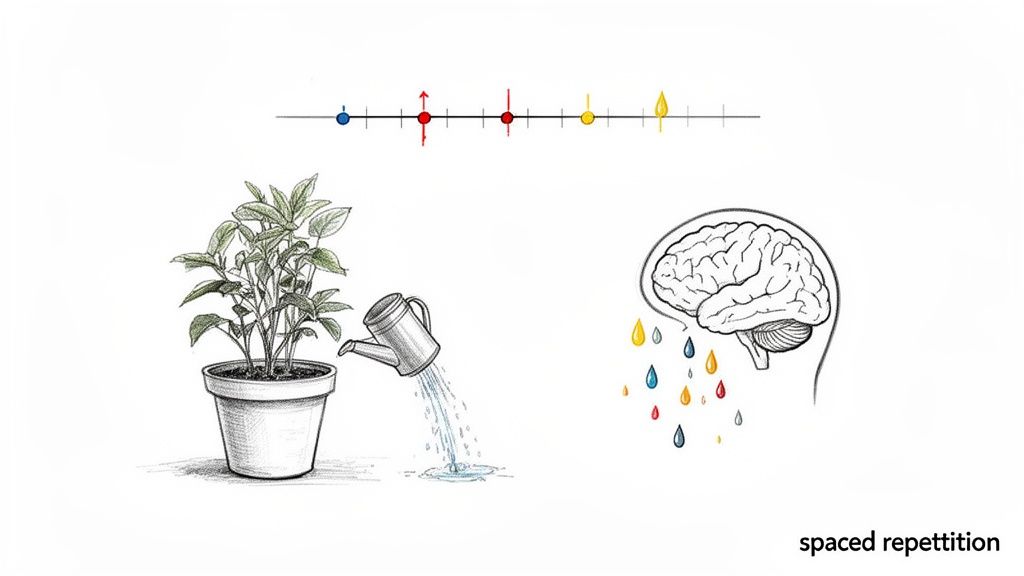
Think of it like tending to a new plant. You wouldn't drown it in water on day one and then ignore it for a month. You also wouldn't water it every five minutes. You give it a drink right when the soil starts to get dry. Spaced repetition does the same thing for your memory, giving it a little boost just when the neural pathways need reinforcing.
The Science Behind The Forgetting Curve
This whole approach is built on a psychological principle called the forgetting curve, first mapped out by Hermann Ebbinghaus way back in the 1880s. He showed that our memory of new information drops off a cliff—exponentially—if we don't actively work to retain it.
Spaced repetition hacks this curve. By strategically reviewing information just as your retention starts to dip (say, to around 80%), you jolt it back up to 100%. But here's the magic: each time you do this, the curve gets flatter. The memory decays more slowly the next time around, allowing for longer and longer breaks between reviews.
This chart paints a clear picture. Cramming gives you a temporary spike, followed by a steep drop. Spaced reviews, on the other hand, consistently push your memory baseline higher and higher.
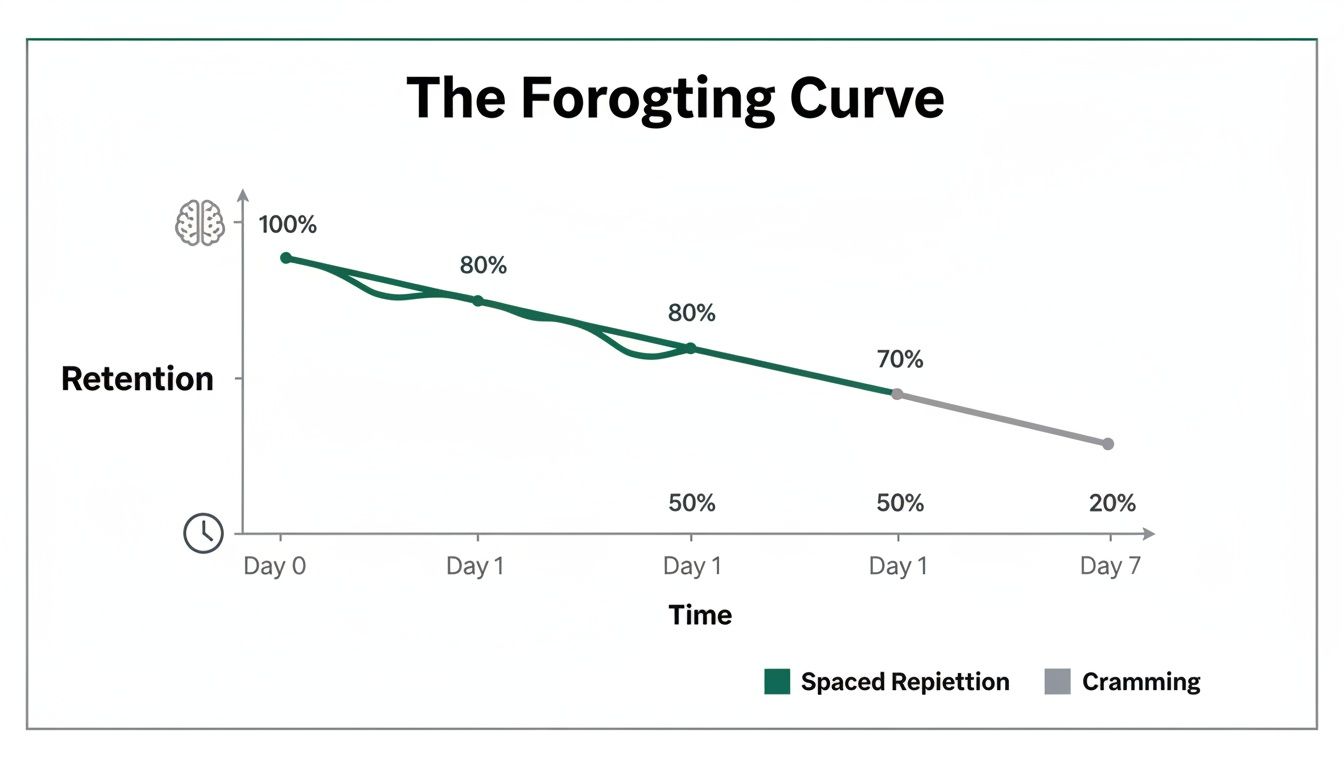 As you can see, each little review session makes the knowledge more durable, letting you wait longer before you need the next one.
Spaced Repetition vs. Cramming
The difference between spaced repetition and its evil twin, cramming (also known as massed practice), is night and day.
- Cramming: This is brute-force learning. You study intensely in one long session right before you need the information. It shoves facts into your short-term memory, but those memories are fragile and fade fast.
- Spaced Repetition: This is strategic learning. You use multiple, short review sessions with ever-increasing gaps between them. This process methodically transfers knowledge from your short-term memory into your much more reliable long-term memory.
"Work involving higher mental functions, such as analysis and synthesis, needs to be spaced out to allow new neural connections to solidify. New learning drives out old learning when insufficient time intervenes."
This isn't just a minor difference. Cramming might get you through tomorrow's quiz, but spaced repetition is what ensures you'll still recall that information months, or even years, down the road. It helps you build a solid, lasting foundation of knowledge.
Of course, setting up a system like this requires a bit of planning. Staying organized is crucial, and you can find great strategies in our guide on how to stay organized at work. And if you really want to get into the nuts and bolts, it's worth checking out resources that help you Master Spaced Repetition Studying.
The Surprising History Of This Learning Method
You might think of it as a modern productivity hack, but the spaced repetition study method is anything but new. Its roots actually stretch back more than a century, built on a solid foundation of psychological research. The whole journey began not with an app, but with a German psychologist named Hermann Ebbinghaus way back in the late 19th century.
 Ebbinghaus was obsessed with memory—and more specifically, forgetting. Through some seriously meticulous self-experiments, he became the first person to scientifically map out the "forgetting curve." He showed just how quickly we lose information if we don't actively work to keep it. His work was the essential first step, proving that forgetting wasn't random but followed a predictable pattern. A pattern that could, in theory, be hacked.
From Theory To Practice
For decades, Ebbinghaus's insights stayed locked away in academic circles. It wasn't until 1932 that the idea of a formal, spaced review system was really put on the table. In his book Psychology of Study, Professor C. A. Mace outlined a practical approach, suggesting that reviews should happen at ever-increasing intervals.
This was the spark that led to the method's first major scientific test. In 1939, H. F. Spitzer ran a huge study with over 3,600 sixth-grade students in Iowa who were learning science facts. The results were crystal clear: students who reviewed material using spaced intervals had far better long-term retention than those who didn't. This was the first definitive, large-scale proof that the method worked. You can dig into more of the historical evidence for spaced repetition's effectiveness on Wikipedia.
Knowing this history is important. It shows that the spaced repetition study method isn't some fleeting trend; it's a technique that has been tested, refined, and proven to work over generations.
The real power of spaced repetition is how it works with your brain's natural process for storing memories. It’s not about cramming information in; it’s about strategically nudging your brain to remember what's important enough to keep.
The Cognitive Science Revival
Even with this early proof, the concept didn't really hit the mainstream until the 1960s and 70s. During this time, cognitive psychologists got interested in practical learning strategies again, kicking off a new wave of experiments that fine-tuned the principles of spaced repetition.
These researchers zeroed in on finding the optimal review schedules to get the most bang for your buck, memory-wise. Their work dug into a few key questions:
- Active Recall: Is it better to just re-read stuff, or to actually try and pull the information out of your memory? (Spoiler: Active recall won by a landslide).
- Interval Timing: What are the most effective time gaps between review sessions?
- Feedback: Does getting immediate feedback on whether you were right or wrong actually help you learn?
The answers they found helped shape the systems and algorithms we use today, from simple flashcard boxes to slick software. They confirmed that forcing your brain to retrieve a memory—not just passively look at it—is the absolute key to forging strong, durable neural connections.
When you understand this rich history, you realize something powerful. The spaced repetition study method is not a fad. It’s a battle-tested technique, grounded in over 130 years of scientific inquiry, that has been proven to work time and time again.
The Real-World Payoff of Spaced Repetition
Okay, so we've covered the history and the science. But the real reason spaced repetition has caught on isn't the theory—it's the results. When you switch to this method, you’re not just tweaking your study habits. You’re fundamentally upgrading how you learn and remember things for the long haul.
The biggest win? You’ll actually remember what you study. We've all been there: you cram for an exam, feel like you've got it down, and a week later, it's all gone. That’s because cramming builds flimsy, short-term memories. Spaced repetition does the opposite. It methodically strengthens the connections in your brain, moving information from "I think I remember this" to "I just know this." It’s the difference between knowledge that fades and knowledge that sticks around for months, or even years.
Get More Done in Way Less Time
This is where it gets really good. Spaced repetition is incredibly efficient because it forces you to spend time on what you're about to forget. Think about it: how much time do you waste re-reading chapters or notes you already know cold? It feels productive, but it's not.
The system smartly flags the information that’s getting a little shaky in your memory and prompts you to review it right at that critical moment. This means you can get better results in a fraction of the time. You stop studying hard and start studying smart.
And this isn't just a feeling; the numbers back it up. A massive meta-analysis looking at over 800 different experiments found that spaced repetition can boost long-term retention by a staggering 200 percent compared to cramming. On top of that, the simple act of testing yourself (active recall) is, on average, 51 percent more effective than just passively re-reading your notes. If you want to dive deeper into the data, you can check out some great learning comparisons on shiftelearning.com.
Build Rock-Solid Confidence and Ditch the Anxiety
There's a hidden benefit here that’s just as important: your mindset. The endless cycle of cramming and forgetting is stressful. It chips away at your confidence and makes you feel like you're just not good at learning things. You put in the hours, but the knowledge feels like it's built on sand.
Spaced repetition completely flips that script. Every time you successfully recall something after a longer and longer gap, you're giving yourself concrete proof that you've mastered it. You start to trust your own memory. This process transforms studying from a frantic, anxiety-fueled scramble into a calm, methodical process of building real competence.
By engaging in active recall at spaced intervals, you are not just memorizing facts; you are building a reliable mental library. This shift reduces the fear of "going blank" and fosters a more positive and sustainable relationship with learning.
When you put it all together, you get a powerful feedback loop that just keeps building on itself:
- You Remember More: The things you learn actually stick around for the long term.
- You're More Efficient: You get better results without having to put in more hours.
- You're Less Stressed: No more last-minute panic sessions.
- You Feel More Confident: You know what you know, and you can trust that knowledge.
These aren't just small perks. They show that spaced repetition isn't just another study hack—it's a system for becoming a better learner for life.
Simple Spaced Repetition Schedules You Can Use Today
Jumping into the spaced repetition study method doesn’t mean you need to sign up for some complex software. Not at all. You can get started right now with a few simple, manual systems that only ask for a little bit of consistency on your part. These methods are perfect for getting a feel for the rhythm of spaced repetition, and honestly, they can be just as powerful as any app.
The whole game is about having a system—any system—to track when you need to review something. Whether you’re the type who loves the hands-on feel of flashcards or you live in your digital calendar, there’s a straightforward schedule that’ll work for you.
The Classic Leitner System With Flashcards
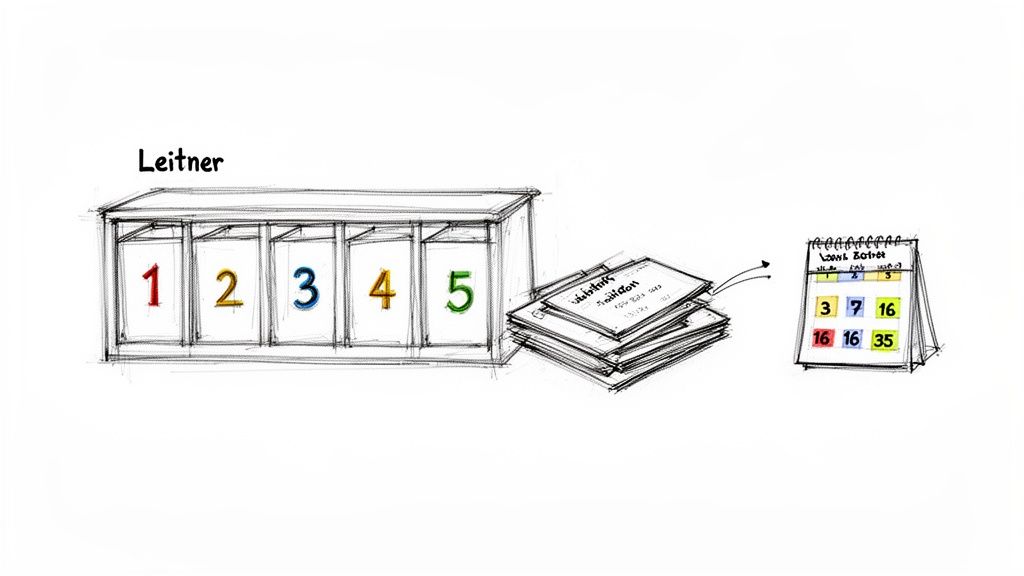
One of the oldest and most reliable manual methods is the Leitner System, dreamed up by German science journalist Sebastian Leitner back in the 1970s. It’s a wonderfully tactile and clever way to put your reviews on autopilot using nothing more than flashcards and a few boxes.
Here's the gist: you sort your flashcards into different boxes based on how well you know the material. The stuff you struggle with gets reviewed all the time, while the concepts you’ve already nailed down show up less and less.
Setting it up is a piece of cake. Here’s how you do it:
- Get Your Gear: Grab a stack of index cards and find three to five empty boxes. No boxes? No problem. Rubber bands work just fine to separate your piles. Just label them: Box 1 (Review Daily), Box 2 (Review Every 3 Days), Box 3 (Review Weekly), and so on.
- Everything Starts in Box 1: Every new flashcard you create goes directly into Box 1. Your job is to go through every single card in this box, every day.
- Promote or Demote: This is where the magic happens. When you review a card, quiz yourself.
- Got it right? Awesome! The card gets a promotion. It moves up to the next box. A card from Box 1 goes to Box 2, one from Box 2 goes to Box 3, and so on.
- Got it wrong? No big deal. The card gets demoted. No matter which box it came from—even if it was in the final box—it goes all the way back to Box 1. Back to daily reviews it is.
This simple set of rules forces you to drill the tough concepts more often, while the easy stuff naturally filters out of your daily grind. It’s automatic.
Using a Simple Calendar-Based Schedule
If you’re not a flashcard person, that’s totally fine. A calendar-based approach is a fantastic, streamlined alternative. This method slots perfectly into a physical planner, your Google Calendar, or even a simple to-do list app. You're basically just building your own custom review schedule.
A really effective schedule, based on what we know about how memory works, follows a predictable pattern for every new thing you learn.
The point of a calendar schedule isn't to be a rigid taskmaster. It's to give you a reliable structure that stops things from slipping through the cracks. It turns that vague idea of "I'll study this later" into a concrete appointment you can't just ignore.
Here’s a proven set of intervals you can use for any new topic or concept:
- 1st Review: 1 day after you first learn it.
- 2nd Review: 3 days after the last review.
- 3rd Review: 7 days after the last review.
- 4th Review: 16 days after the last review.
- 5th Review: 35 days after the last review.
Let’s make this real. Say you learn a new batch of vocabulary words on October 1st. You’d immediately schedule your reviews for October 2nd, then October 5th, October 12th, October 28th, and so on. This approach fits right into the tools you already use every day.
If you’re trying to build this into a more organized life, checking out some of the best daily routine apps can help you weave these study blocks into your existing schedule. The beauty of the calendar method is that it works just as well on paper as it does on a screen.
Choosing Your Spaced Repetition System
So, which manual system should you pick? It really boils down to your personal style. Are you a hands-on learner who likes physical objects, or do you prefer the clean efficiency of a digital calendar? This table should help you decide.
FeatureLeitner System (Flashcards)Calendar-Based MethodPrimary ToolPhysical index cards and boxesDigital/physical calendar or to-do listBest ForTactile learners; memorizing discrete facts (vocab, dates)Integrating study into an existing digital workflowSetup TimeLow (just need cards and boxes)Minimal (uses tools you already have)FlexibilityLess flexible; system is tied to physical cardsHighly flexible; can apply to notes, concepts, or cardsEffortRequires daily sorting and physical managementRequires upfront scheduling for each new itemAutomationSelf-automates based on performance (right/wrong)Requires manual scheduling of future datesUltimately, there’s no wrong answer here. The Leitner system is great if you enjoy the process of physically interacting with your study materials. The calendar method is perfect if your life already revolves around a digital planner. Pick one, give it a shot, and see how it feels.
Automating Your Learning With Spaced Repetition Apps
While pen and paper work, let's be honest—technology can make the spaced repetition study method feel almost like cheating. Digital tools take care of all the tedious scheduling, sorting, and tracking, leaving you free to focus on what actually matters: learning. These apps run sophisticated algorithms to pinpoint the exact moment you need to see a piece of information again, right before it slips from your memory.
 The biggest win here is sheer efficiency. A good app can juggle thousands of flashcards across dozens of subjects. Imagine trying to do that with index cards—it would be a logistical nightmare. This kind of automation lets you scale your learning without getting buried in admin.
Top Spaced Repetition Study Apps
When people talk about dedicated spaced repetition software, several names almost always come up. These tools are built from the ground up for this specific learning method, but they often serve slightly different crowds.
- Anki: This is a free, open-source beast favored by serious learners—think medical students cramming anatomy or language lovers aiming for fluency. It's famous for its deep customization, letting you tweak just about every part of the algorithm. You can create your own detailed flashcards with text, images, and audio, or you can dive into a massive library of community-built decks on pretty much any topic.
- Quizlet: Offering a more polished, user-friendly experience, Quizlet packages learning into different study modes and games, which makes it feel more approachable. The huge draw for Quizlet is its library of user-generated content, with millions of pre-made study sets ready to go.
- SuperMemo: This is the original spaced repetition software, created by one of the researchers who pioneered the algorithms. It’s incredibly powerful but is often seen as less user-friendly than more modern alternatives.
The real magic of these platforms isn't just the digital flashcards. It's the smart engine running in the background. The software automatically brings the concepts you struggle with to the front of the line, making sure your limited study time is always spent where it counts the most.
A Hidden Gem for Everyday Spaced Repetition
But what if you want to use spaced repetition for things other than memorizing facts for an exam? What about cementing a new business concept, remembering key details about a client, or practicing a new coding function? This is where a different kind of tool becomes a small but mighty productivity hack.
Enter Recurrr. It’s not a full-blown study app, and it doesn't pretend to be. Instead, it’s a simple, almost invisible tool that lets you create reminders that follow a spaced repetition schedule. You can set a task to review a project brief, practice a sales pitch, or recall a new framework, and Recurrr will ping you at growing intervals: tomorrow, in three days, next week, and so on.
This approach makes Recurrr a fantastic supplement to your main productivity tools. It injects the core principle of spaced repetition—reviewing at the perfect time—right into your daily workflow, no complex flashcard system required. For anyone searching for the best recurring task app to build consistent habits, its simplicity is a game-changer. It’s a bit of a hidden gem for applying this powerful memory technique to the practical, everyday knowledge that really moves the needle in your professional life.
Common Mistakes To Avoid When Getting Started
Jumping into the spaced repetition study method is a fantastic first step towards better learning. But like any powerful tool, there are a few common ways people trip up right at the beginning. Knowing these pitfalls ahead of time is the best way to build a study habit that actually sticks.
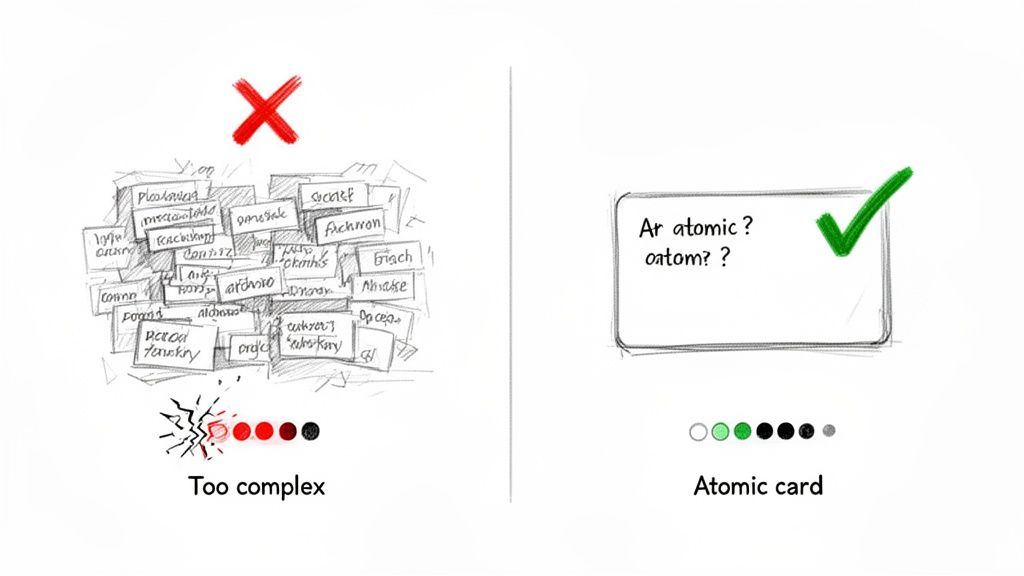
One of the biggest mistakes is making your flashcards way too complicated. It's so tempting to try and cram an entire chapter summary onto a single card, but that completely misses the point. The real magic happens when you test yourself on one tiny, specific piece of information. This is often called creating "atomic" notes.
So, instead of a card that just says "World War II," break it down. Make separate cards for questions like, "What year did World War II begin?" or "Who were the primary Axis powers?" This forces your brain to do the hard work of pinpointing a single fact, and that’s what forges a strong, lasting memory.
Overlooking The Power of Active Recall
Another classic error is just passively reviewing your cards. Simply flipping a card, reading the answer, and telling yourself "yeah, I knew that" is no better than rereading your textbook. The real mental workout—where memories are actually built—happens when you struggle a bit to pull the answer out of your head.
True active recall means you genuinely try to answer the question before you dare peek at the other side. That effort is a powerful signal to your brain, telling it, "Hey, this is important! Hang onto this." It's okay if you get it wrong; that feedback is exactly what helps correct the memory for your next review.
The core of the spaced repetition study method is not just seeing information again, but actively pulling it from your memory. This retrieval practice is the engine that drives long-term retention.
At the end of the day, this whole process is about engaging your mind, not just glazing over text with your eyes.
Breaking The Streak and Getting Discouraged
Look, consistency is everything. Missing a day or two of reviews isn't the end of the world, but the real danger is letting that snowball. It's a common story: reviews pile up, the task starts to feel huge and overwhelming, and pretty soon, you've abandoned the system altogether.
Don't shoot for perfection. Aim for consistency. A quick, 15-minute review session every single day is infinitely more powerful than a marathon two-hour cram session once a week. The habit is what matters, not how long you spend in any single session.
- Make it easy: Find a non-negotiable spot in your day for reviews. Maybe it's while your morning coffee brews or right when you wrap up work.
- Don't overcommit: Start by adding just a few new cards each day. This keeps your daily review pile from becoming a monster.
- Recover quickly: If you miss a day, just get back to it the next. Don't let one slip-up become an excuse to quit.
Falling behind can be stressful, no doubt. If you want some tips on managing that feeling, you might find our guide on how to stop being overwhelmed by tasks useful. Steer clear of these common mistakes, and you'll be well on your way to making this powerful learning technique work for you long-term.
Got Questions About Spaced Repetition?
Even after getting the hang of the spaced repetition study method, a few practical questions almost always come up. Let's tackle the most common ones head-on so you can get started with confidence and sidestep any early hurdles.
 Think of this as your quick-start guide to clear up any lingering confusion. These answers will help you implement the method correctly from day one.
How Long Should Each Review Session Be?
Short and sweet is the name of the game. Your goal is consistency, not cramming. Most people find that 15-25 minutes a day is the sweet spot.
This is worlds more effective than a single, long session once a week. It keeps the habit from feeling like a chore and prevents you from burning out. The real magic of spaced repetition comes from that consistent, daily recall, not from staring at your notes for hours on end.
Can This Method Work For Complex Skills?
Absolutely. The secret is to break the skill down into its smallest, most fundamental pieces. Instead of a huge goal like "learn to play guitar," you create prompts for the tiny micro-skills that get you there.
For instance, you might focus on:
- Practicing the C major chord for two minutes.
- Playing a specific five-note scale without a single mistake.
- Mastering one fingerpicking pattern.
By creating a prompt or reminder for each tiny component, you're constantly reinforcing the building blocks of that bigger skill. It makes a massive, daunting task feel totally achievable.
The core principle here is atomization. Break down any subject or skill into the smallest testable units you can imagine. This forces active engagement and makes the learning process both measurable and manageable.
What Happens If I Miss A Review Day?
Don't sweat it. One missed day won't derail all your hard work. The system is surprisingly resilient to the occasional hiccup.
Just do the missed review as soon as you can and hop back on your regular schedule. Digital apps will automatically adjust their algorithms to account for the delay. If you’re using a manual system like flashcards, just pick up right where you left off. The most important thing is to not let one missed day turn into a missed week.
How Do I Create Effective Review Prompts?
Stick to the "minimum information principle." Every flashcard or prompt should test only one single piece of information.
Instead of a broad topic like "The American Revolution," you need to get super specific with question-based prompts.
- Poor Prompt: "Causes of the Revolution"
- Effective Prompt: "What was the purpose of the 1765 Stamp Act?"
When you frame prompts as direct questions, you force your brain to perform active recall. That's way more powerful for building strong, lasting memories than just re-reading a statement or a list of facts. This one small change can make a huge difference in your results.
Ready to apply the power of spaced repetition to your daily routines and professional goals? Recurrr makes it easy to set up automated, spaced reminders for anything you want to remember, from client details to new skills. It's the hidden gem for integrating this learning hack into your everyday life. Start automating your habits today.