

Preventing burnout isn't about some grand, sweeping gesture. It's about catching the subtle warning signs before they snowball into chronic exhaustion. It's learning to tell the difference between a tough week and that deeper, more nagging feeling of depletion that signals a real problem.
Recognizing the Signs Before Burnout Takes Hold
Burnout doesn’t just show up one Monday morning. It’s a slow burn. Think of it as a gradual erosion of your energy, your passion for your work, and your belief that you can actually get things done. It often hides in plain sight, disguised as normal work stress.
It's all too easy to dismiss it. "It's just a phase," we tell ourselves. "I just need to push through." But ignoring these early nudges from your mind and body is a huge mistake. The real trick is learning to listen.
This isn’t just a feeling, either. The burnout crisis is real, with the World Health Organization now officially recognizing it as an occupational phenomenon. We’re talking exhaustion, mental distance from your job, and a drop in professional effectiveness. Research shows that nearly 50% of workers across major economies report feeling burnt out. That’s a clear signal this is a systemic problem, not a personal failure.
Are You Stressed or Truly Burning Out?
Figuring out the difference between stress and burnout is your first, most important step. It’s a game-changer.
Stress is usually about over-engagement. You're running on adrenaline, feeling a constant sense of urgency, maybe even hyperactivity. You have too much going on. Burnout is the polar opposite: it's about disengagement. You feel empty, helpless, and emotionally drained. You have nothing left to give.
Think about the classic "Sunday Scaries." If you're stressed, Sunday evening might bring a jolt of anxiety about the week's deadlines. If you're sliding toward burnout, that dread starts creeping in on Saturday, maybe even Friday afternoon, poisoning your entire weekend.
To help you get a clearer picture, this flowchart is a pretty handy tool for assessing where you stand.
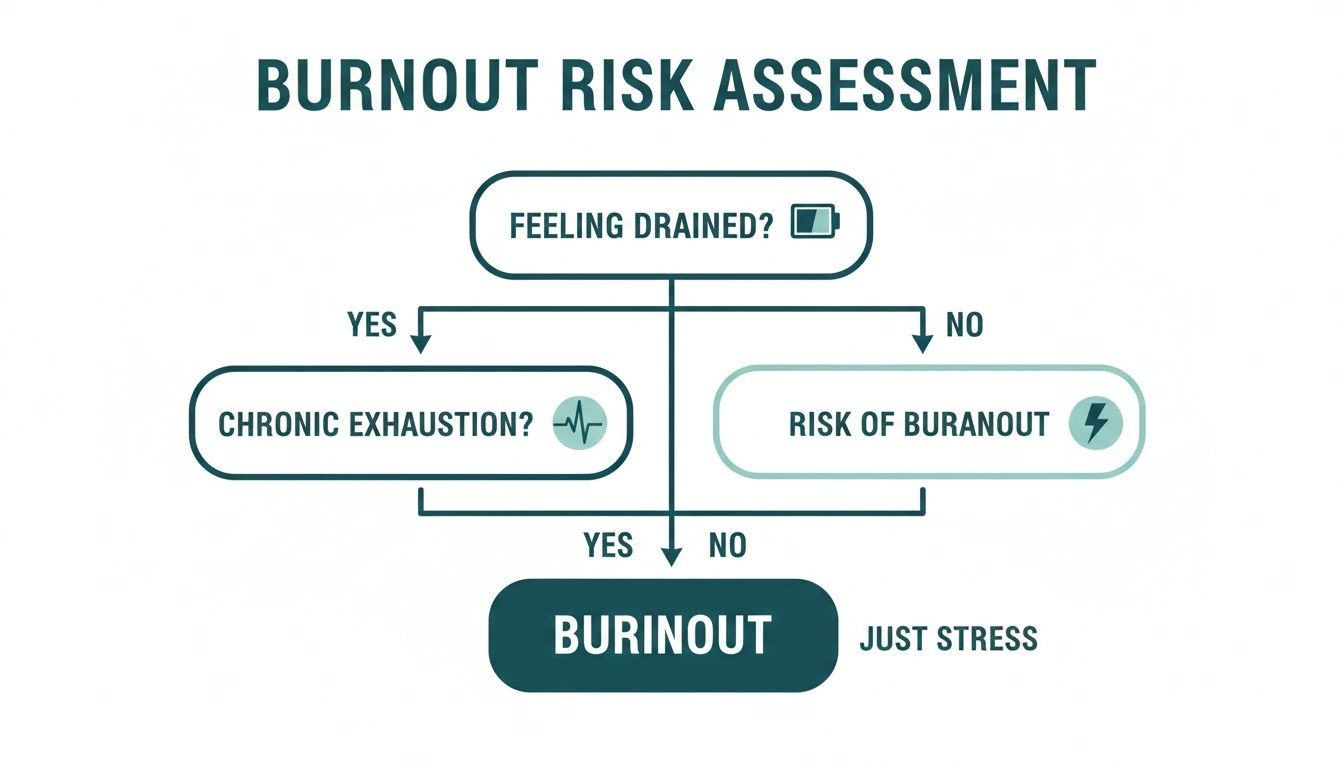
As you can see, feeling drained is one thing. We all get there. But when it becomes a chronic, unrelenting state of exhaustion, you're crossing the line from stress into burnout territory.
To make it even clearer, let's break down the key differences.
Stress vs Burnout Key Differentiators
This table helps you quickly distinguish between the pressures of stress and the exhaustion of burnout, allowing for more accurate self-assessment.
| Indicator | Stress | Burnout |
|---|---|---|
| Primary Emotion | Anxiety, urgency, hyperactivity | Helplessness, apathy, emptiness |
| Engagement Level | Over-engaged, everything feels critical | Disengaged, detached from work |
| Energy Level | Loss of energy, but still running on fumes | Total exhaustion, feeling depleted |
| Sense of Control | Feels like you're losing control | Feels like you have no control at all |
| Outlook | Can still see a light at the end of the tunnel | Feels hopeless, like nothing will ever change |
| Impact on Health | Primarily physical (headaches, GI issues) | Primarily emotional (cynicism, depression) |
Recognizing which column you're in is the first step toward getting back on track.
Common Early Warning Signs
Beyond just feeling tired, a few other subtle signs can tip you off that you're on the road to burnout. Paying attention to these shifts gives you the power to act before things get worse.
- Growing Cynicism: You start feeling negative or overly critical about your job. The work that used to feel meaningful now just feels like a pointless grind.
- Reduced Professional Efficacy: You feel like you're just spinning your wheels and not accomplishing anything. It's more than just a dip in productivity; it's a deep-seated feeling that your work doesn't matter or that you're just not good at it anymore.
- Irritability and Impatience: Little things set you off. You might find yourself snapping at coworkers or loved ones over nothing. Your patience is shot.
- Physical Symptoms: Don't ignore your body. Chronic headaches, stomach problems, or getting sick more often can be physical signals that you're under an unsustainable amount of strain.
Here's a key takeaway: Burnout isn't just about working too many hours. It's often fueled by a mismatch between your values and your work, a lack of control, or feeling like your hard work goes completely unnoticed.
Spotting these symptoms isn't about blaming yourself; it's about gathering data. This self-awareness is your best defense. Once you see the patterns, you can start tackling the root causes. A simple, powerful next step is to get your tasks in order and reclaim a sense of control. Learning how to stay organized at work can bring immediate relief by cutting through that feeling of being overwhelmed.
To really get a handle on this, digging into proven strategies to prevent burnout can give you a much bigger toolkit to work with, both for yourself and for your team.
Building Your Practical Anti-Burnout Toolkit
Knowing you're on the path to burnout is one thing; knowing how to get off it is another entirely. The answer isn't some dramatic life overhaul. Instead, preventing burnout at work comes down to building a personal toolkit of small, sustainable habits that protect your mental energy, day in and day out.
This isn’t about piling more onto your plate. It's about getting smarter with the energy you already have. By focusing on these micro-habits, you create a buffer against the chronic exhaustion that defines burnout.
Master Your Focus with Time-Blocking Techniques
One of the biggest culprits draining our mental batteries is context switching. Research shows it can take over 23 minutes to get back into a state of deep focus after just one interruption. When your day is a constant stream of pings, emails, and "quick questions," your brain never gets a chance to work efficiently. No wonder you feel exhausted and ineffective by 5 PM.
The Pomodoro Technique is a refreshingly simple way to fight back. It's a structured method for deep work:
- Pick one thing. Just one.
- Set a timer for 25 minutes. For those 25 minutes, you work on that task and nothing else. No email, no Slack, no phone.
- Take a 5-minute break. Get up, stretch, grab some water. Do anything but work.
- Repeat. After four of these cycles, take a longer break of 15-30 minutes.
This method trains your brain to concentrate in short, focused sprints, shielding you from the mental drag of multitasking.
Enforce True Psychological Detachment
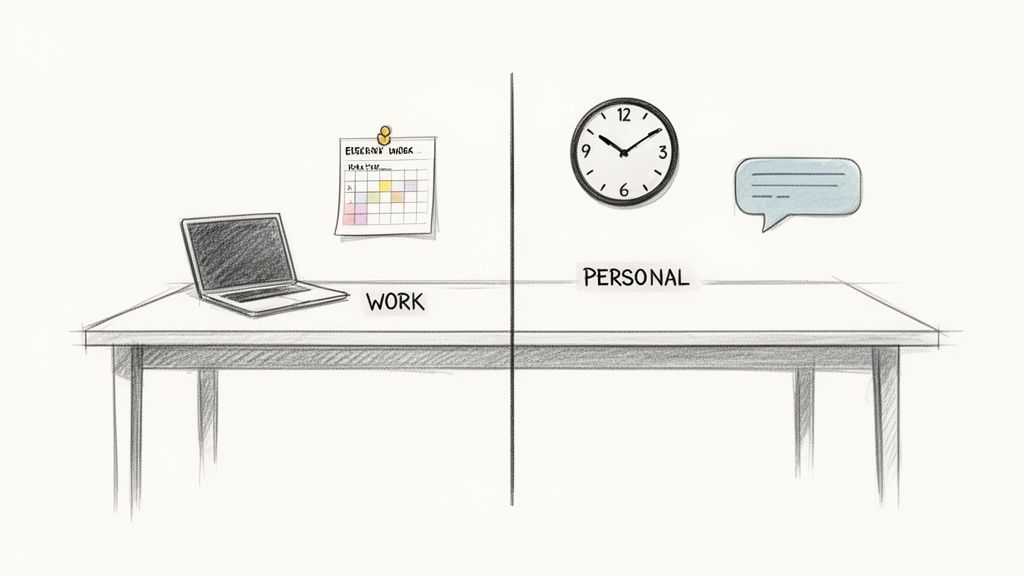
To really prevent burnout at work, you have to draw a hard line between your professional and personal life. This is about more than just logging off on time; it's about psychological detachment. That means truly disengaging your brain from work thoughts when you're off the clock.
Without it, you're never actually resting. You're still chewing on work problems, rehearsing conversations, and mentally running through tomorrow's to-do list.
A simple way to enforce this is to schedule "no-work" blocks directly into your calendar. Treat a 60-minute walk, dinner with family, or time for a hobby with the same seriousness as a client meeting. These aren't just breaks; they are non-negotiable recovery periods.
Reduce Cognitive Load with Routine Automation
Every small decision you make—what to work on first, when to follow up, remembering to send that weekly report—chips away at your finite mental energy. This constant drip of micro-decisions leads straight to decision fatigue, a huge contributor to burnout.
This is where routine automation becomes your secret weapon. By automating the small, recurring tasks that clutter your mind, you free up precious brainpower for the creative, strategic work that actually matters.
Think about all the repetitive checklists, follow-up emails, and status updates you handle. This is where a small productivity hack like Recurrr comes in handy. It's not another complex project management app you have to learn. Instead, it’s an invisible tool that works quietly in the background, handling those repetitive tasks for you.
By setting up recurring email reminders or automated task assignments, you permanently remove them from your mental to-do list. This small shift can have a massive impact on your daily cognitive load, helping you conserve energy and prevent that slow drain toward burnout. For more ideas on managing your schedule, check out our guide on time management tools for work that can bolster your anti-burnout strategy.
How to Manage Your Workload and Set Clear Boundaries
That feeling of being constantly, relentlessly overwhelmed? It's one of the fastest routes straight to burnout. Learning how to prevent burnout isn't just about shuffling your calendar around; it's about managing your energy and fiercely protecting your focus. The only way to do that is by taking control of your workload and setting firm, crystal-clear boundaries.
Without these guardrails, your work will inevitably expand to fill every waking moment. Trust me, you can't win this battle by simply trying to work harder or faster. The real victory comes from being more strategic and intentional about where your energy actually goes.
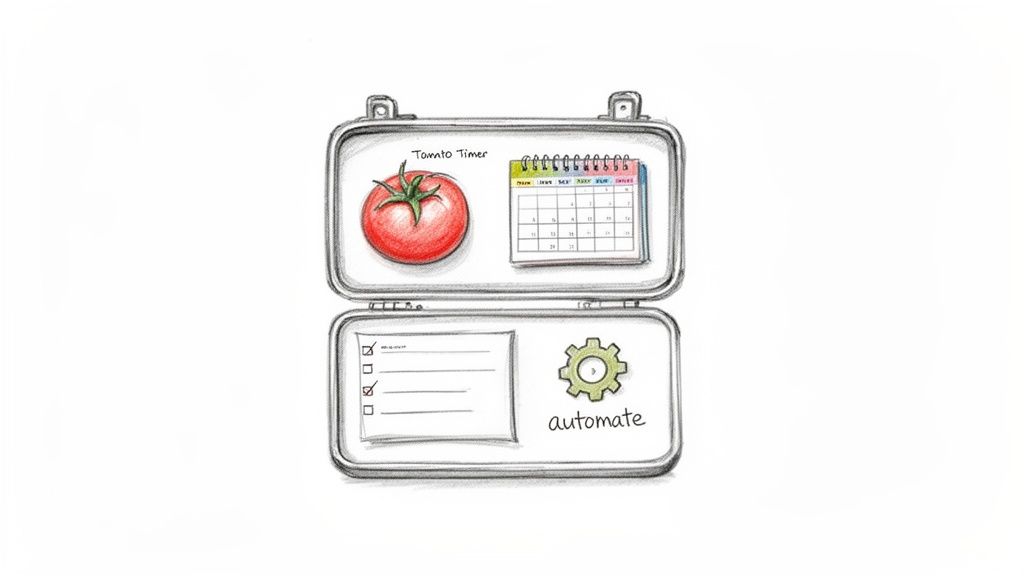
This is about more than just learning to say "no." We're going to get into practical ways to prioritize with ruthless efficiency and communicate your capacity without feeling like a jerk. It's time to create a sustainable structure for your work life.
Prioritize Your Tasks with Ruthless Efficiency
Let's be honest: not all tasks are created equal. When your to-do list feels like a mountain, the first step is to realize that some items are just small hills, while others are massive boulders blocking your path. Treating everything as a top priority is a recipe for pure exhaustion.
A ridiculously effective tool for this is the Eisenhower Matrix. It's a simple framework that helps you sort tasks by urgency and importance, forcing you to make conscious decisions instead of just reacting to the next ping or email.
- Urgent & Important (Do First): These are the fires and the absolute must-meet deadlines. Get them done.
- Important, Not Urgent (Schedule): This is where the magic happens—strategic planning, relationship-building, and long-term projects. Proactively block time in your calendar for these before they turn into last-minute emergencies.
- Urgent, Not Important (Delegate): These tasks scream for attention but don't actually need your specific expertise. They are prime candidates for delegation. Learning how to delegate tasks effectively can be an absolute game-changer for your workload.
- Not Urgent, Not Important (Delete): These are the time-sucks and distractions. Get rid of them and don't look back.
Using this matrix regularly helps you flip from a reactive, "firefighting" mindset to a proactive one, making sure your best energy is spent on what truly moves the needle.
Learn to Communicate Your Capacity
Setting boundaries often fails because we're afraid of how we'll sound. Nobody wants to come across as uncooperative or "not a team player." The secret is to frame the conversation around shared goals and realistic outcomes, not just your personal limits.
Instead of a flat-out "no," try using more collaborative language.
Scenario: Your manager drops a new project on your desk with a tight deadline, but your plate is already overflowing.
Instead of saying: "I can't, I'm too busy."
Try this: "This project sounds exciting, and I want to make sure it gets the attention it deserves. Right now, my focus is locked on finishing Project A and Project B for their deadlines. Can we look at my current priorities together and see how this new task fits into the timeline?"
This approach completely changes the dynamic. You're showing that you're engaged and responsible, turning a potential conflict into a strategy session. You're not refusing the work; you're ensuring you can deliver high-quality results on everything you commit to.
Reclaim Your Time from Digital Presenteeism
In our hyper-connected world, the workday doesn't really have an "off" switch anymore. That constant pressure to be "always on"—answering emails at 10 PM, checking Slack on a Sunday—is a huge driver of burnout. This whole phenomenon is called digital presenteeism, and it creates the illusion of productivity while silently draining your mental batteries.
You have to actively build walls around your personal time. It won't happen by itself.
- Set Clear Communication Hours: Put your available hours right in your Slack status or email signature (e.g., "I respond to messages between 9 AM and 5 PM EST"). This sets a clear expectation for everyone.
- Disable Notifications: Seriously, turn off work-related notifications on your phone after hours. Every little buzz or ping is an intrusion that yanks your brain right back into work mode, preventing you from truly unplugging.
- Schedule Your Log-Off: Just like you schedule meetings, schedule your own departure. Set an alarm for 15 minutes before you need to stop working. Use that time to wrap up loose ends, jot down a plan for tomorrow, and then close your laptop and walk away.
By setting these digital boundaries, you send a powerful message—to your team and, more importantly, to yourself—that your time outside of work is non-negotiable. This is absolutely critical for long-term sustainability.
Even the best individual strategies will feel like bailing out a sinking ship if the company culture is the problem. Let's be honest: burnout is an organizational issue, not just a personal failing. To really prevent it, we have to shift our focus from "fixing" the individual to building a team environment where exhaustion simply can't thrive.
This isn't just a manager's job; it's on everyone. It’s about creating a system of support that makes sustainable work the default setting, not a special exception. And the absolute cornerstone of that system is psychological safety.
The Bedrock of Psychological Safety
Psychological safety is just a fancy way of saying people feel safe enough to take risks. It means team members are comfortable speaking up, admitting they messed up, or talking about challenges without getting shut down or punished.
When you have that safety net, people are way more likely to raise a hand and say, "Hey, I'm swamped," long before they hit a wall.
Leaders are the ones who have to lay this foundation. It's built with small, consistent actions:
- Celebrate the hustle, not just the win. When you only praise successful projects, you're accidentally creating a fear of failure. Make sure to acknowledge the hard work and learning that happens, even when things don't go to plan.
- Be vulnerable first. When a leader openly talks about their own struggles or mistakes, it gives everyone else permission to be human. It’s a powerful signal.
- Don't just permit breaks—promote them. Saying "take breaks" is one thing. Actively asking, "Have you actually stepped away for lunch today?" carries so much more weight.
A Note on Supporting Younger Generations
This need for a supportive culture is hitting younger employees especially hard. Gen Z, in particular, is burning out at rates that blow older generations out of the water. In the UK, a shocking 83% of Gen Z frontline workers report burnout symptoms, compared to 66% of older workers. It’s the same story in the US, where Gen Z has officially become the most burned-out generation.
A huge piece of this puzzle is a deep-seated fear of speaking up. A staggering 42% of employees believe their career would take a hit if they brought up mental health concerns. So, they suffer in silence, feeling immense pressure to keep performing.
This means genuine support from managers isn't just a nice-to-have; it's non-negotiable. Create explicit opportunities for honest conversations. Regular, informal one-on-ones that are actually about well-being—not just a project status update—can be a total game-changer.
Practical Steps for Leaders to Prevent Team Burnout
Beyond creating that safe space, managers can put some very real, tangible practices in place to build a burnout-proof culture. These actions get right to the root causes of overload and chronic stress.
- Protect your team's focus time. Constant pings and interruptions are an absolute energy vampire. Champion "deep work" blocks where meetings are off-limits, and encourage everyone to be ruthless with their notifications.
- Kill ambiguity. Vague roles and shifting priorities are exhausting. Make sure every single person on your team knows exactly what they're responsible for and how their work fits into the bigger picture. When priorities change, over-communicate it and adjust workloads accordingly.
- Model the behavior you want to see. This is it. This is the big one. If you're firing off emails at 10 PM, you're setting the cultural norm, period. Log off at a reasonable time, take your vacation, and talk openly about why disconnecting matters. Your actions will always shout louder than your words.
Building this kind of environment is an ongoing effort, but one that pays off massively in team cohesion and results. For a deeper dive, check out our guide on https://recurrr.com/articles/how-to-improve-team-efficiency with sustainable practices.
To really cement a burnout-resistant culture, companies should also look into formal policies, like providing clear information on reasonable adjustments for mental health at work. These structural supports show you’re actually committed, not just talking a big game.
The Financial Imperative of Preventing Burnout
We tend to file burnout prevention under "wellness perks"—a nice-to-have, but not a core business strategy. That view isn't just outdated; it's incredibly expensive. Ignoring burnout isn’t just a cultural failure. It's a massive financial drain that hits the bottom line, hard.
It's time to shift the conversation. Preventing burnout isn't an employee "cost." It's a strategic "investment," and frankly, the numbers don't lie.
The Staggering Hidden Costs of Burnout
So, what does an exhausted, disengaged workforce actually cost? A lot more than you’d think. The financial fallout shows up in subtle yet corrosive ways—lost productivity, higher turnover, and more sick days. These aren't just minor operational headaches; they're multi-million dollar problems hiding in plain sight.
The World Health Organization estimates that depression and anxiety cost the global economy $1 trillion a year in lost productivity. In the US alone, disengaged employees—a direct symptom of burnout—cost their companies 18% of their salary each. Globally, that adds up to a staggering $8.8 trillion in lost productivity every year.
And it gets more specific. Research from McKinsey & Company found that attrition and disengagement combined cost S&P 500 companies an estimated $282 million annually. You can dig into more of these sobering stats over at Plansponsor.com.
Burnout is a silent tax on your organization's resources. Every disengaged employee represents a direct loss in potential output, innovation, and customer satisfaction.
The reality is clear: when your employees are running on empty, so are key parts of your business.
From Employee Cost to Strategic Investment
Reframing how we approach burnout prevention is mission-critical. Putting money into supportive policies and tools isn't just about employee well-being; it's about safeguarding the financial health of the entire organization.
Just look at the direct expenses tied to burnout:
- Turnover and Recruitment: Replacing a burned-out employee is a killer expense. Estimates suggest it costs anywhere from 40% of their salary for a frontline worker to a whopping 200% for a leader. That’s before you even factor in the loss of institutional knowledge.
- Lost Productivity: It’s not just that disengaged employees are less productive. Their lack of enthusiasm can be contagious, dragging down team morale and overall output.
- Increased Absenteeism: Burned-out employees take more sick days. This disrupts workflows and puts an extra burden on the rest of the team who has to pick up the slack.
The Clear Return on Investment
Here’s the good news: investing in burnout prevention delivers a clear, measurable return. When you create an environment that prioritizes sustainable performance, you see significant gains.
This means building a culture where workloads are actually manageable, boundaries are respected, and people feel psychologically safe. It also means providing tools that genuinely reduce friction and cognitive load. This is where a small productivity hack can make a huge difference without adding more complexity.
Think about an invisible tool that automates repetitive reminders or tasks. It quietly reduces the mental clutter that fuels burnout, freeing people up to focus on the work that really matters.
Ultimately, the business case for how to prevent burnout at work is undeniable. Companies that proactively invest in their people aren't just doing the right thing—they're making a savvy financial decision that protects their most valuable asset and secures their long-term success.
A Few Common Questions About Burnout
Look, navigating burnout isn't a straight line. It brings up a lot of real-world, messy questions. How you handle these tough situations is what really matters. So, let’s get into some of the most common questions I hear and tackle them with advice you can actually use.
This isn't just theory. Think of it as a practical guide for managing your energy, speaking up for yourself, and building a career that doesn't drain you dry.
What’s the Absolute Fastest Way to Start Recovering From Burnout?
There's no magic pill, but the quickest way to start the recovery process is to pull the emergency brake. You need to create some real distance from whatever's causing the stress.
That means taking a real break. Even a long weekend can do wonders if you actually, truly unplug from all things work-related. No emails, no Slack, no "just checking in."
During that time off, get back to basics. Focus on sleep, eat food that makes you feel good, and maybe go for a walk. When you get back, your first job is to pinpoint the one or two biggest things fueling your burnout. Is it the sheer volume of work? One particular high-stress project?
Then, you have to have a direct, solution-focused chat with your manager about making a change, fast. It’s like stopping the bleeding before you can think about long-term healing.
How Do I Tell My Boss I'm Burnt Out Without Tanking My Career?
It's all in how you frame it. You need to approach this conversation as a performance issue, not just an emotional one. This protects you professionally while still getting to the heart of the problem.
Instead of blurting out, “I’m totally burnt out,” try something more proactive. You could say: “I’m really committed to producing my best work here, but I’ve noticed my focus and energy have been slipping lately. To make sure I can keep performing at a high level, I’d like to talk about how we could adjust my workload or shift some priorities.”
See the difference? This frames you as a responsible team member who’s managing their own capacity to deliver. It shifts the conversation to a shared goal—maintaining high performance—which is a much more constructive place to start.
Can Productivity Tools Actually Make My Burnout Worse?
Oh, absolutely. If you're not careful, the very tools meant to help can just add to the noise. Complicated project management systems or apps that ping you with notifications all day can seriously increase your cognitive load. It creates that awful feeling of being watched and always behind.
The trick is to be ruthless about which tools you let into your life. They should reduce friction, not create more admin for you.
This is where an "invisible" tool like Recurrr can make a surprising difference. It’s a small productivity hack that you can use in addition to your main tools. Instead of trying to organize your entire life, it just works in the background, automating the tiny, repetitive tasks that chip away at your mental energy. By taking those recurring reminders off your plate, it frees up your focus for the work that actually counts.
Is It Even Possible to Avoid Burnout in a High-Pressure Job?
It is, but it requires a different mindset. In a demanding role, preventing burnout isn't about eliminating the pressure. It’s about becoming a master of managing your energy and setting rock-solid boundaries. You can only sustain high performance if you build in deliberate recovery.
This means being incredibly disciplined with your time. You schedule breaks into your day, and—here's the key part—you actually take them. It also means building recovery rituals outside of work that let your brain and body fully switch off.
And you have to get ruthless about what you say "yes" to. Really understand which tasks create the most value and get comfortable letting the less important stuff slide.
By automating the small, repetitive tasks that drain your mental energy, you can free up valuable focus for the work that truly matters. Recurrr is designed to be a simple, invisible hack that runs quietly in the background, handling your recurring checklists and reminders so you don't have to. Take back your mental energy and build more sustainable routines by visiting https://recurrr.com.